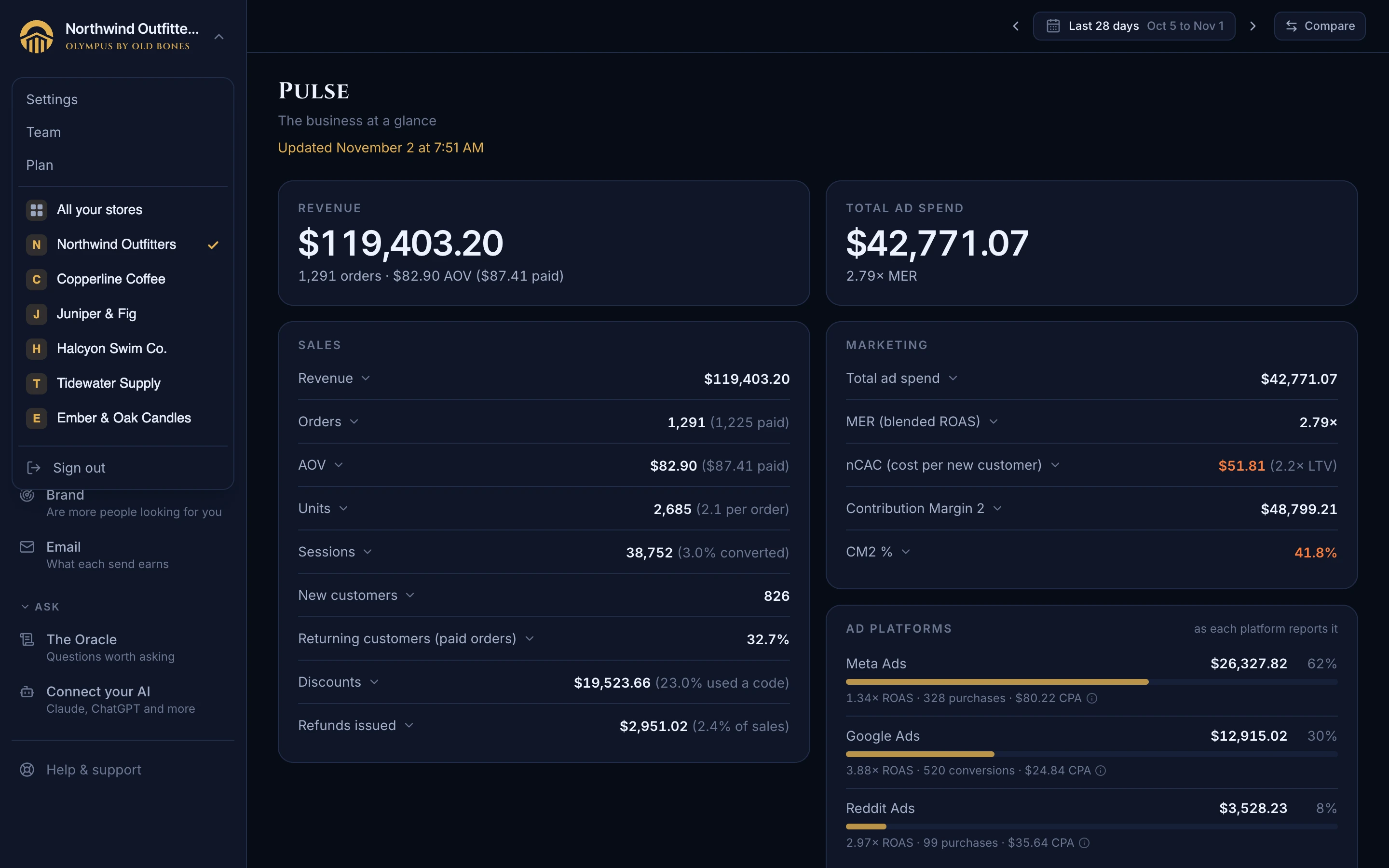
The features behind it, from the full list. Free is everything you connect and see; Pantheon adds asking about it in your own AI.
Free
Click your store's name at the top of the menu to see every Olympus you own or are on the team of, and open any of them in the same tab. Each store keeps you signed in for 30 days from the last time you used it, so switching is a click. Work under more than one email? Add each one at oldbones.ai/stores and they share one list. No store ever sees the others you work on.
Sound familiar? Signing in again and again, or digging through emails for a link, to check a second brand or a client's store.
Where: The store's name, top of the menu; oldbones.ai/stores
Free
Invite anyone by email. Admins can run the store's Olympus with you: connections, targets and the team. Members read every page and change nothing. Everyone sees the same numbers, product costs and margins included, because a team needs them to do its job. Everyone signs in with their own email, at oldbones.ai or the store's own address, by emailed link or password, and a forgotten password resets by email. Need help? Turn on support access and the Olympus team can sign in to troubleshoot, until you turn it off.
Sound familiar? Sharing one login with everyone, or screenshotting numbers into Slack so the team can see them.
Where: Settings, Team & access
Free
Every ad platform claims credit for your sales, and a sale two platforms both touched is claimed by both. Olympus shows each platform's spend and claims side by side, then puts all the claims against what your store actually took, so you know what's real. Each platform's figures open their own history, including an estimate of what it pays for each new customer, not just each purchase it claims. Meta's figures can be read on one attribution rule for every ad set, so a change of ad set settings never looks like a change in performance, and the page tells you when one happened.
Sound familiar? Meta, Google and Reddit dashboards that together claim more sales than you made, and a CPA that "improves" because an agency changed how purchases are counted.
Where: Pulse, Ad platforms card; a page for each platform, and a page for each of its figures
FreeMore on Pantheon
Every change in your ad accounts, kept for good: budgets, bids and cost caps, campaigns and ads turned on or off, new ads, creative and targeting edits, with who made each one and the before and after. Changes no person made, like Google's auto-applied recommendations, stand out. Google keeps its own history for only 30 days, so Olympus saves it every night; Reddit keeps none, so Olympus compares its settings night to night. Your AI can read it too, so "why did spend jump on Tuesday?" gets an answer.
Sound familiar? A number moves and nobody remembers what the agency, a teammate or the platform itself changed that week.
Where: Ads, What changed; each platform's Changes, on every plan; your AI on the Pantheon plan
Free
Email's revenue as Shopify counts it, on the attribution model you pick, beside sales and matching Shopify's own Marketing report. Klaviyo's own figure sits next to it, exactly as its dashboard shows it, with how many times larger it is. Every flow, with its job, sends, click rate and both revenues, and every campaign with its audience, click rate and revenue. Clicks lead, since Apple's privacy opens make open rates meaningless. Compare turns on its change against the period before or the same period last year. Without Klaviyo, Email still shows what Shopify credits to email, and says what connecting Klaviyo would add.
Sound familiar? Klaviyo says email made four times what Shopify does, nobody can say which to believe, and open rates of 75% that mean nothing.
Where: Email
PaidPantheon
On the Pantheon plan, connect Claude, ChatGPT or another AI app to Olympus with one sign-in and ask questions in plain words: why was last week down, which platform's spend pays back, what changed after the price increase. It answers from your real numbers, knows what each one means and when it's final, and can't change anything. Each teammate signs in as themselves. On Free the connection still works: your AI says what Pantheon would let it answer, and never guesses a number.
Sound familiar? Exporting spreadsheets into a chatbot that doesn't know what your numbers mean.
Where: Connect your AI; Pantheon plan