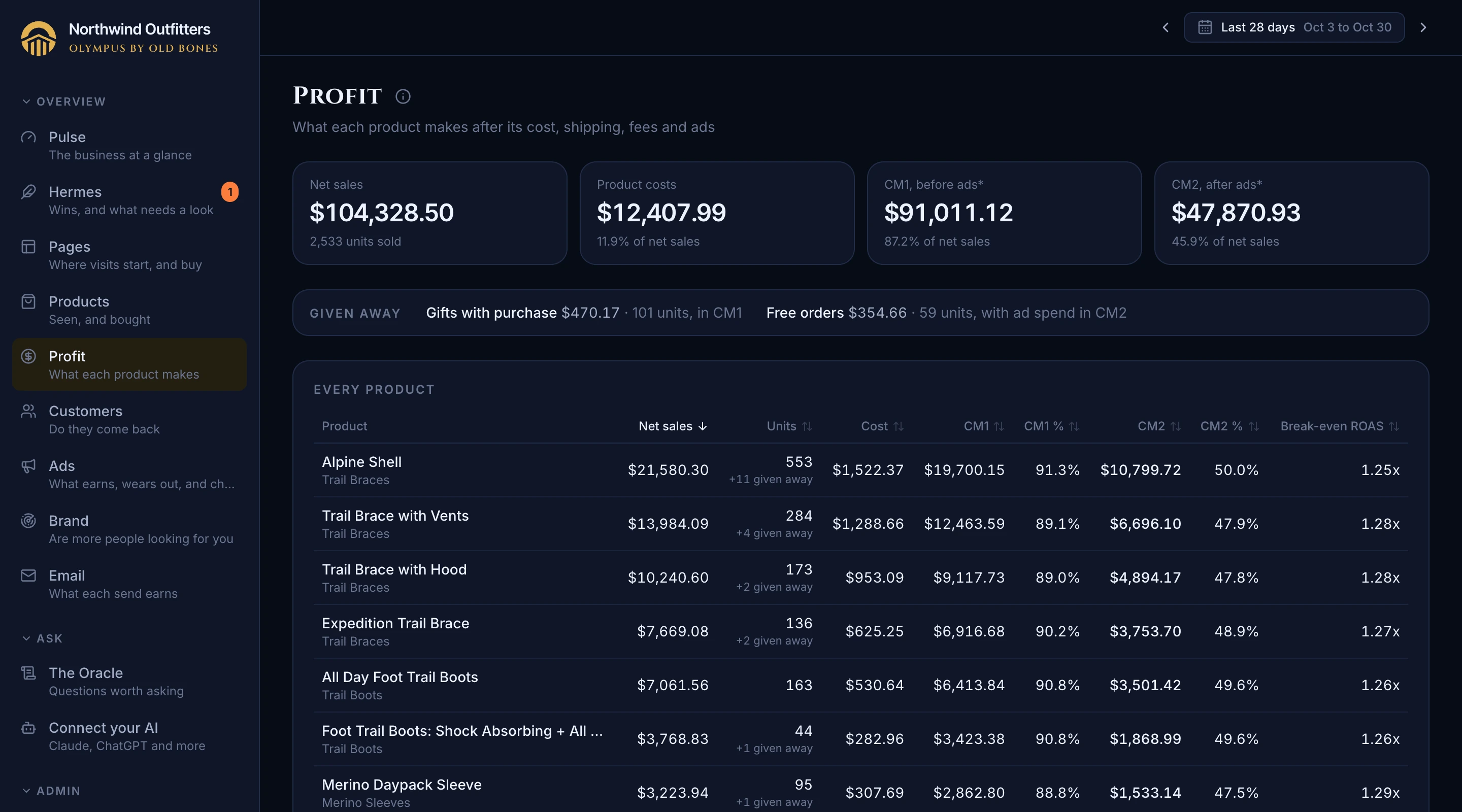
What each product and each sale leaves after product costs, shipping, fees and ads, and the break-even every decision rests on. Free is everything you connect and see; Pantheon adds asking about it in your own AI.
FreeMore on Pantheon
For any period, every product's sales, its product cost, and what's left after its share of shipping and payment fees (CM1) and of ad spend (CM2), as dollars and as a share of its sales. Sort by what each one leaves, and see which products can't carry their share of the ads. Each one has its own break-even ROAS, counted the way ad platforms count revenue, so an ad set that sells one product is judged against that product. A product sold without a cost in Shopify shows "No cost" instead of a margin built on nothing, and Olympus says how costs are shared, so you know what the number rests on. What you give away never counts against the product you gave: gifts with purchase (a free pick over a cart total) are part of what orders cost to fill, and free orders (product sent to athletes, creators, promotions) sit with your ad spend as the marketing they are. It stops at contribution margin: rent, salaries and the rest belong in your own books.
Sound familiar? Knowing what the store makes overall but not which products make it, because the per-product margin apps cost $35 to $250 a month.
Where: Profit; your AI on the Pantheon plan
Free
Olympus works out where your ads stop paying from your own margin: the MER below which ads cost more than they bring, and what a new customer can cost before their first order, or their first year, stops paying it back. Margins leave out the sales tax you collect for the state, and the lines are counted the way ad platforms count revenue, so they compare straight with what the platforms report. Each line sits next to where you are now. It shows how much of your sales have a product cost in Shopify, names the products that don't, and says plainly what Shopify can't see, so you know the lines are a best case. The lines are drawn on MER's and nCAC's charts too, one click to hide.
Sound familiar? Not knowing the ad spend or cost per customer where ads start losing money, because working it out takes a margin spreadsheet most never build.
Where: Settings, Targets; MER's and nCAC's charts
Free
Every margin depends on the Cost per item your products have in Shopify. Settings, Product costs checks them every night: when they're all there it says so in a line, and when they're not it lists the products sold without a cost, the costs that look like a typo ($0, or more than the price), and the products whose cost is the biggest share of what they sell for, each with a link to fix it in Shopify. A product that costs nothing on purpose (a care package of used gear, stickers, a sample) is marked once and counts at $0 everywhere, never as missing or a typo. A guide explains what to put in the field and what to leave out.
Sound familiar? Margins that look healthier than they are because a few products never had their cost entered, and nobody noticed.
Where: Settings, Product costs; a note on Profit when costs are missing
FreeMore on Pantheon
In Settings, Product costs, say whether your Cost per item is landed (the unit, plus freight and duty, plus packaging) or the unit price only. Your AI reads the answer before it quotes a margin, so it never has to guess whether your margins are complete, and tells you plainly when they read high.
Sound familiar? An AI second-guessing your margins ("these look like factory prices") when you've already entered landed costs, or trusting them when you haven't.
Where: Settings, Product costs; your AI on the Pantheon plan
PaidPantheon
Ask your AI whether a price change paid and it reads every change Olympus found in your sales or you logged, one way: the four weeks before against the weeks after, set against every product whose price didn't move, so a slow month isn't blamed on the price. The verdict (pays, costs, or no clear change) is on the margin dollars each product brings in a day, against how far they move in an ordinary month, with the rule stated so you can see why. Products you changed together are judged together, and ask twice and you get the same answer.
Sound familiar? Raising a price and never knowing whether it worked, or getting a different answer depending on which weeks and which number someone looked at.
Where: Your AI on the Pantheon plan